

EnBloc Holmium Laser Enucleation of the Prostate (Step by Step)
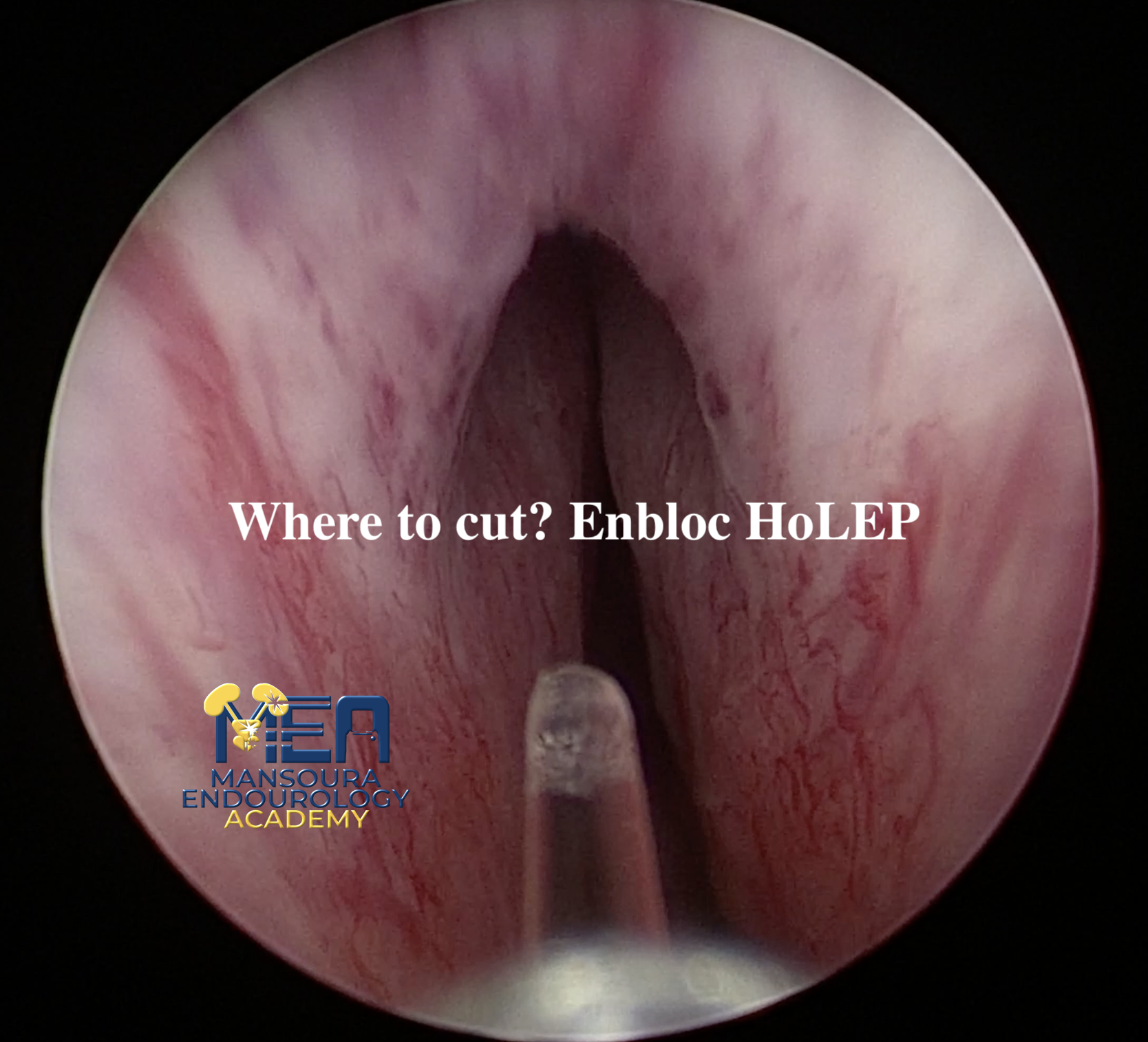
In the era of early apical release, en bloc holmium laser enucleation of the prostate seems to be an appealing approach. However, marking where to start, especially anteriorly, is frequently described as a mysterious step, especially in the early learning curve. Veil-sparing lobe-by-lobe holmium laser enucleation of the prostate has been previously described, with optimised continence-related outcomes (https://pubmed.ncbi.nlm.nih.gov/38742554/). Furthermore, it offers a stepwise approach for learning in an ABC manner. A similar approach could be utilized for en bloc holmium laser enucleation of the prostate following I PAS A, B, C, D. The procedure starts by making an inverted I for incision, a U-shaped incision in front of the veru montanum. This incision is a mucosa-only incision following the lateral apical prostate bulge till 3 and 9 o'clock positions on the left and right lobes, respectively. Then P, for plane development, using the peak of the resectoscope left and right lobes are bluntly enucleated with laser-assisted plane connection. Then, after S, for sphincter release or strip cutting, the advantage of the veil-sparing technique. You easily identify where to cut, just inside the sphincter ring, maintaining a good mucosal veil covering the sphincter. Laser cutting from side to side optimizes the dissection without the need to guess. Dissection continues anteriorly till the bladder neck. Characteristic bladder neck vertical fibers are reassuring. B. for bladder neck dissection that starts by laser cutting of the vertical fibers from side to side between 2and 10 o'clock positions on the left and right lobes,s respectively. C For C-shaped baso-lateral bladder neck dissection. This step entails 2 kinds of movements: rotating one and pulling back one, aiming at the dissection of the base of the prostate adenoma off the capsular fibers of the bladder neck. Dissection starts from the right lobe from 10 to 7 O`clock positions and from 2 to 5 O`clock positions on the left lobe. The key to the success of this step is the hugging action, which means continuous pressure on the adenoma during dissection, and the dissection is always from lateral to medial on both sides to avoid undermining of the bladder trigone. The endpoint of this step is the visualisation of the ureteral orifices. D, for detachment. As we approach the bladder neck, the adenoma is now ready to be flipped inside the bladder. Bluntly from side-to-side, the adenoma is pushed up towards the bladder using the peak of the scope. The final attachment is basal at the bladder neck. This attachment is cut only from side to side to avoid stripping of the trigonal mucosa. The procedure is concluded by careful hemostasis and morcellation of the intravesical adenoma. Intact mucosal covering of the sphincter ring with a reactive sphincter is the final assuring sign.
#enucleation #laser #prostate #holep